Welcome:
Language:
 ∷
∷

∷
 ∷
∷

In modern medical devices, cooling fans are not only responsible for reducing heat and preventing overheating, but they also affect the operating environment, user experience, and measurement accuracy. Precision instruments such as liquid chromatography systems, analyzers, and patient monitors are extremely sensitive to noise and require high reliability. Even if airflow is sufficient, an improperly selected fan can produce excessive noise or instability, impacting laboratory or clinical settings.
This article explores why medical instruments are sensitive to fan noise, analyzes causes and effects, and introduces practical engineering strategies using AVC fans to achieve low-noise, high-reliability cooling.
Medical equipment faces strict noise requirements:
Laboratory and Hospital Environment
Operators of liquid chromatography systems and analyzers require high concentration. Excessive fan noise interferes with work and can affect test accuracy. In hospitals, high noise levels from monitors can disturb patients.
Precision Measurement Requirements
Sensors and circuits in precision devices are sensitive to vibration and noise. Fan instability or resonance can cause micro-movements or electromagnetic interference, impacting measurement results.
Continuous Operation
Medical devices often operate 24/7. Even a moderately noisy fan can create accumulated background noise over time, affecting both operators and patients.
Hence, sensitivity to fan noise is linked to environmental requirements, measurement accuracy, and user comfort.
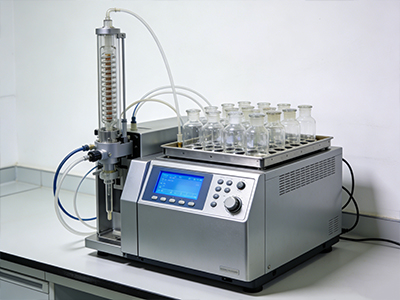
Aerodynamic Noise
Fan blades create turbulence and pressure fluctuations when moving air. High airflow or high static pressure fans generate more aerodynamic noise.
Mechanical Noise
Friction in bearings, unbalanced blades, or loose installation can produce mechanical noise. Reliable long-term operation is critical in medical equipment; low-quality bearings increase noise over time.
Installation and Airflow Path
Bends in ducts, resistance changes, and gaps between the fan and chassis can amplify noise. Optimizing airflow paths is essential in compact medical devices.
User Experience: High noise disrupts laboratory operators or clinical staff.
Measurement Accuracy: Vibrations can interfere with precision sensors, causing data drift.
Patient Comfort: Noise from bedside monitors affects patient well-being.
Operational Risk: Continuous noise can mask abnormal sounds, delaying fault detection.
Reducing noise is thus critical for both comfort and reliability.
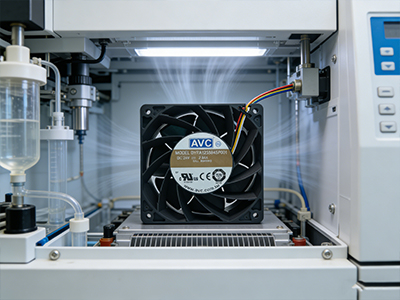
Choose Low-Noise, High-Reliability Fans
AVC fan series, including DC axial fans DV and JC14038, feature optimized blade design and high static pressure, providing effective cooling with minimal noise.
Optimize Installation and Airflow Path
Proper fan placement, minimized bends, and anti-vibration mounts reduce mechanical and aerodynamic noise.
Use PWM or Adjustable Speed Control
Dynamic fan speed control maintains cooling efficiency while reducing noise during lower heat load conditions.
Ensure Long-Term Reliability
AVC fans use high-quality bearings and durable materials, ensuring stable operation and consistent low-noise performance over extended periods.
In a liquid chromatography system project, the initial solution used three small fans to cool the control board, producing noise above acceptable lab levels. The engineering team applied an optimized solution:
Conducted thermal-fluid simulation to analyze airflow and temperature distribution
Replaced three small fans with one AVC JC14038B12H-2 fan
Delivered a sample for rapid installation and performance verification
Results:
Effective temperature control of the control board
Significantly reduced noise, meeting laboratory standards
Fewer fans, simplified system design
Long-term stable and reliable operation
This case demonstrates the effectiveness of AVC fans in achieving low-noise, high-reliability cooling for medical instruments.
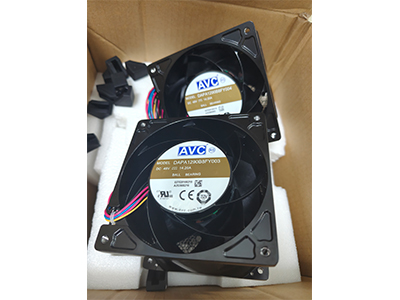
Medical instruments are sensitive to fan noise due to laboratory environments, precision measurement requirements, and continuous operation. Proper fan selection and system-level optimization ensure:
Low-noise operation
Efficient cooling
Long-term reliability
AVC fans, with multiple models, performance levels, and high-reliability bearings, provide reproducible and scalable cooling solutions for medical instruments, ensuring stable operation and high user comfort.